
Fans hold roses in memory of Bobby Weir.
Rachel Bujalski for Rolling Stone

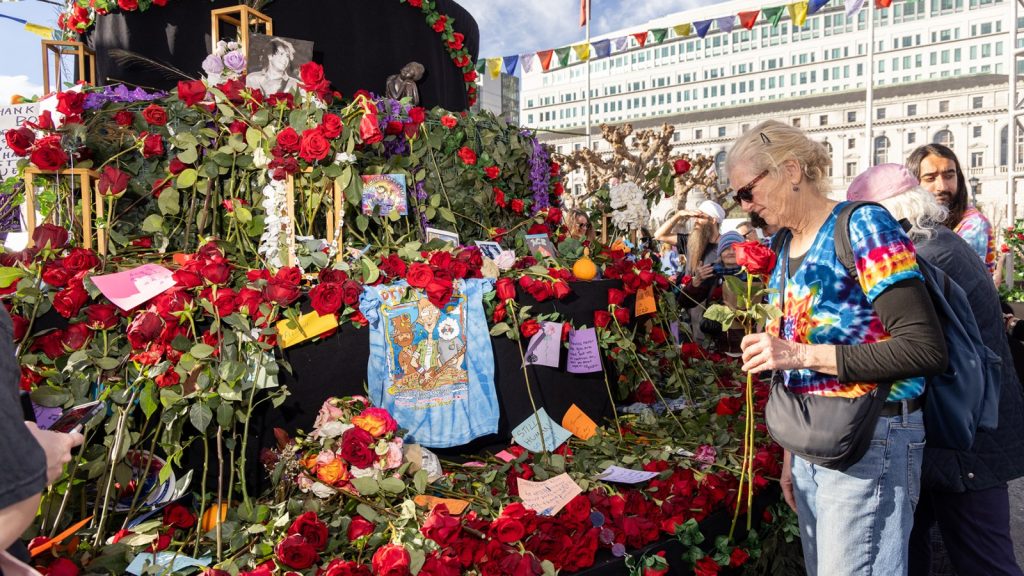
San Francisco gave Bobby Weir one more glorious Saturday. Exactly a week after his death, some 20,000 Deadheads and other fans, along with family and many friends, gathered at the Civic Center Plaza, just across Polk Street from City Hall, and across Grove Street to the Bill Graham Civic Auditorium.
They convened after many of them had walked, in his honor, up the city’s main boulevard, Market Street, to the Plaza.
The organizers of the memorial celebration announced that there would be no live music. This would not be a concert. No matter. Everybody showed up. And they got their music, albeit a mixtape blasting out in high fidelity.
Every attendee was offered a long-stemmed red rose, courtesy of the Weir family, handed out by members of Wharf Rats, the Dead’s sobriety/recovery organization. I also saw one person giving away joints.
Unlike the memorial celebration for Jerry Garcia in August, 1995, the one for Weir — entitled “Homecoming: Celebrating the Life of Bob Weir,” to signal his return to the band’s San Francisco home base — fans were casual about showing up and paying tribute. There were no overnight campers.
One diehard Deadhead, pen name “Taper Tom,” showed up at 6:30 a.m. — “and I got a parking spot!” – and saw no one else around, except maybe Darla and Adam, in from Seattle and settled into the plaza by 8 a.m. By 9:30, Chris Knorzer, a 57-year-old high school ceramics teacher in Rocklin, north of Sacramento, had secured his seat, in front of a tree. “I liked the messages,” he said of the Dead, “and all the love they shared. They steered clear of political matters but still encouraged people to vote.”
When the Dead mixtape got to “Uncle John’s Band,” I experienced the first of several flashbacks.
From my 1995 Rolling Stone piece about Jerry Garcia:
One day early in 1970, we got an impromptu visit from the management and several members of the Dead. The band had just wrapped up recording Workingman’s Dead. They knew the album was something special, and they wanted to share it right away. Magazine staffers gathered in the editor’s office and listened in awe to pedal steel licks and tight, pretty harmonies — from the Dead! — on “Uncle John’s Band,” “Dire Wolf” and “Casey Jones.” They had been getting some inspiration from their friends, Crosby, Stills and Nash. Our minds, as someone would later say, were young and blown.
And to think, only a few years before, as a slightly stoned member of the audience, I saw them, the Airplane and all the others at the Fillmore Auditorium and the Avalon Ballroom. And at the Human Be-In early in 1967. The start of it all.
Just before the program began, the P.A. blasted Weir’s song, “One More Saturday Night,” and a parade of speakers, on videos and in person, took over.
San Francisco’s Mayor, Daniel Lurie, recalled seeing Dead & Company before one of their last three concerts in Golden Gate Park, celebrating the Dead’s 60th anniversary. “[And Weir] starts saying, ‘Thank you for having us.’ I was like, ‘No no no, thank YOU for having us.’ Even as he was preparing to give his time, his music, his heart, back to the city, Bob was still profoundly grateful.” The mayor took pride in informing the audience that the Dead had performed over 320 concerts in more than 24 venues — all in San Francisco.
Homecoming’s producers, including Another Planet Entertainment, did a miraculous job, getting a couple dozen speakers committed — whether in person or by video — inside of a week. Taped tributes came from San Francisco 49ers George Kittle and Nick Bosa, followed by Bruce Hornsby, who praised Weir for his adventurous (he said “odd”) time signatures and McCoy Tyner-esque harmonies. Grace Potter noted that her son was with her, playing with his flight simulator, which led to a “nice sendoff” for Weir. At her cue, her son shouted, “Fly, Bobby, Fly!”
Other video tributes featured Ramblin’ Jack Elliott, Dead archivist David Lemieux, Warren Haynes, Primus’ Larry LaLonde and Les Claypool, who praised Weir’s penchant for wearing “cool shorts,” and Wynonna Judd, who sang a bit of “Amazing Grace,” adding that she was able to sing it for Weir (Judd also appeared at the MusiCares tribute to the Grateful Dead in 2024). “Thanks for embracing me,” she said. “You changed this country girl’s life.” More video tributes came from Jack Johnson, Don Was, Rhino Records head Mark Pinkus, Trey Anastasio and Dave Matthews, who thanked Weir for leaving “a treasury of music and experiences.”
Joan Baez strode onto the stage to a sustained ovation and, “to send you on your way,” sang a bit of “Freedom,” including freedom from any more sound checks, before turning the podium over to Congresswoman Nancy Pelosi. “I know we come here with heavy hearts,” she said, but she also felt gratitude to have known Weir, who was “curious, kind… He understood something essential about America.” She noted that the Dead were among the recipients of the last Kennedy Center honors — “when they were truly the Kennedy Center honors.”
Fans hold roses in memory of Bobby Weir.
Rachel Bujalski for Rolling Stone
People always ask her what her favorite Dead song is, the former Speaker of the House said, giggling. “My favorite Dead song is whatever Bobby is singing at that moment.”
Said Pelosi: “What I will remember most about Bobby is his humanity, his warmth, his humor, his generosity of spirit.”
Willie Nelson, seated alongside son Lukas Nelson, did a cameo, wearing a T-shirt reading, “la-dee-fuckin’-da.” And Bill Kreutzmann, also on video, was equally light-hearted, telling how his first gig with Weir and Garcia was at a pizza parlor in Menlo Park. “If I remember correctly, long story short, it was pretty good pizza.” Weir, he said, was “sometimes overlooked because he stood next to Jerry. After all, he was ‘The Other One.’ But he proved to be just as valuable — and just as irreplaceable.” He concluded: “Sleep in the stars, my brother. I love you forever.”
John Mayer delivered the eulogy of the day. Exactly 30 years younger than Weir, Mayer’s tenure in Dead & Company gave new life to the band’s catalog while opening the door to another generation of devotees. “He gave me musical community. He gave me this community,” he said, his voice beginning to break as he indicated the thousands of fans overflowing the Civic Center Plaza. The community broke out in a lengthy ovation as Mayer rubbed his chin. He then aimed a message specifically to Deadheads:
“The excitement you felt boarding a plane or packing up the car to travel miles to see the shows was the same excitement I felt flying to the next city, working out the set list in a group chat, meeting up with the band on stage for a sound check, and getting ready for that magical moment when we’d take the stage and discover whatever magic was in store for us that night.”
He closed by quoting a song — not by Weir or any member or friend of the Dead, but by Leon Russell. He said he could hear Weir singing, from “A Song for You,” “But now I’m so much better, so if my words don’t come together, listen to the melody, ‘cause my love is in there hiding.”
Back on the video screens, Sammy Hagar offered a montage of merry photos and video clips, including one in which it was Hagar, not Weir, donning shorts. He concluded: “I’ll see you when you see me.”
The audience exploded again when they recognized Mickey Hart, behind shades, walking to the podium. “Bob would’ve loved this,” said Hart. “This is so soulful.” Like his fellow surviving member of the Dead, Kreutzmann, Hart accentuated the positive, and the light-hearted. “Bob was funny, and he loved funny,” he said. “He was the band clown… comic relief for the tedium of being on the road. You could always depend on him to have a toy gun or a noisemaker or something going on at airports to attract attention and challenge the rules.”
Another flashback: I recall talking with him for a Rolling Stone piece about the Dead’s 15th anniversary, which they celebrated with, what else, a tour. Garcia, naturally, dominated the article, but one day in Boulder, Weir took over.
“What we stand for, and what we represent to a lot of people, is misfit power,” he declared. Sitting nearby was John Barlow, Weir’s childhood pal and co-writer who was serving as road manager for the tour. “We’re positive miscreants,” he said. “Weir and I always vied for biggest asshole in prep school.” The two had just attended a reunion at Fountain Valley School in nearby Colorado Springs.
“I don’t want to talk about that,” Weir snapped. But Barlow barreled on: “We saw a lot of people our age who definitely had a little soul death,” he said. Weir, who was 32 on this day, couldn’t help but agree. “Twenty, 30 years older than me — and chronologically maybe a couple of years younger.” He swore: “I refuse to get hammered by age into an old fart,” he said. “I’m not clutching to my youth, but there is a spirit here of ‘We gotta keep things fresh. I see friends of mine who haven’t managed to keep things fresh in their lives, and I find that lamentable. I think we relate more readily to people who haven’t had the life kicked out of them. Kids — and older people — who are gonna stay young forever.”
Mickey Hart closed by inspiring the crowd to clap to a song — “Love is real, not fade away.” The drummer led the Bo Diddley beat until the audience took over, clapping while Hart bid farewell, then spontaneously group-singing the Buddy Holly song to an empty stage. They, now, were the performers.
The program concluded on several high notes provided by Bobby’s girls: His widow Natascha and their daughters, Monet and Chloe.
Natascha Weir speaks alongside daughters, Chloe and Monet.
Rachel Bujalski for Rolling Stone
Monet shared with the audience that Weir was dyslexic — “but he didn’t let that stop him. He loved learning.” His biggest wish, she said, was “that the music of the Dead continue into perpetuity.” Younger sister Chloe, who has photographed Weir and Dead & Company extensively, seconded that sentiment. “In 300 years, when the music from this time period is being discussed, I want the Grateful Dead to not only be in that conversation, but to be still evolving. This 300-year legacy is an aspiration my dad often spoke of. He believed if we played our cards right, these past 60 years would only be the beginning.”
Natascha, overwhelmed by emotion, had to steady herself a couple of times at the podium. But she gathered herself and told the audience that there were two sides to Weir: “The quiet, meditative side and the fierce lion force of nature” (often felt onstage, she said). “We’ll touch on both.” She called for a 108-second moment of silence (“It’s kind of long, but he liked to push limits”), followed by a theatrical “Bobby bow” to the audience, and then an explosion of human noise: “Yell and scream,” Natascha instructed. “You have to do it really loud because he’s hard of hearing.”
The audience screamed as they were told, with thousands of hands up, reaching for the skies. Natascha looked up and spotted a hawk. A red tail hawk, in fact, according to Linda Kelly, editor of the Haight Street Voice. Natascha cried to the bird: “Hey, darlin’!”
Natascha told about how Weir would visit friends who were ailing or close to death and sing and play for them. She then summoned Mayer and all the speakers and crew members who were backstage to come out and sing “Ripple.” With Mayer leading the vocals and filling the stage — the plaza, even — with his ringing guitar, the music took over again.
As the cast and crew celebrated each other on stage, the mixtape came back on. The song had to be, and was, “One More Saturday Night.”
Rush Break Out ‘A Farewell to Kings’
“I never thought I’d see this again,” Rush‘s Geddy Lee said early in night four...
Oliver Tree, ‘Life Goes On’ Singer, Dead at 32
Eccentric musician known for his viral videos among six people who died in when two helicopters...
All of the Celebrity Appearances
The singer has been inviting stars, from Lola Young to Bad Gyal, to share their deepest...
Keith Urban, Charles Kelley Weigh In
Buy me a boat? That’s so 2015. This year, country music — or at least a few of its...