By
Source /
Published on Monday, 04 May 2026 13:35 PM /
No Comments
/ 34 views
All hail the guitar solo — one of the most indestructibly great art forms in all of modern music. There’s nothing quite like the thrill of a glorious six-string explosion — a long, twisted, never-ending saga that stretches from “Free Bird” to “Purple Rain,” from “Johnny B. Goode” to “Eruption.” Some classic solos come from virtuoso shredders; others are just a blast of awesomely sleazy licks. But they’ve all burned their way into our brains.
Rolling Stone’s list of the 100 greatest guitar solos of all time is a full-blast mix of different genres, generations, grooves. We travel all over history, with blues pioneers, hippie jammers, punk rockers, metal warriors, funkateers. We’ve got surfers, stoners, starship troopers, and steely knives. We’ve got legends like Jimmy Page, Jerry Garcia, and Jimi Hendrix, alongside seasoned slingers St. Vincent and John Mayer, and young rebels like Geese and MJ Lenderman. Some are solos that always make you hum in the car, or play air guitar using the nearest vacuum cleaner. A few you could even sing in the shower. (Hey, we don’t judge. Guitar worship is a sacred thing.) We didn’t include any jazz (Les Paul and Mary Ford’s “How High the Moon” is a pop tune by a guy with a jazz background), and a few entries are instrumentals.
The criterion isn’t sales or airplay — just the six-string brilliance on display. We also took into account that the solo makes the song, and that it doesn’t just repeat the melody line. (A bonus: if you can sing it note-for-note.)
As you can imagine, the arguments we had assembling this list got louder than the final minute of “Voodoo Chile.” Note: This is about solos, not riffs, which is why our Deep Purple classic is “Highway Star” instead of “Smoke on the Water.” Some of these stretch out for double-digit minutes, exploring the cosmos. Others just need a few seconds to make their impact. But a guitar trip can be a cry from the heart, full of rage, joy, hunger, pain, or maybe all at once.
Some of these 100 solos are influential cult classics; others are so universally beloved they’re banned at your local guitar shop. Every fan would compile a different list, and that’s the point. But it’s a salute to the guitar-solo tradition and all the rituals that go with it. So crank up the volume, and read this list loud.
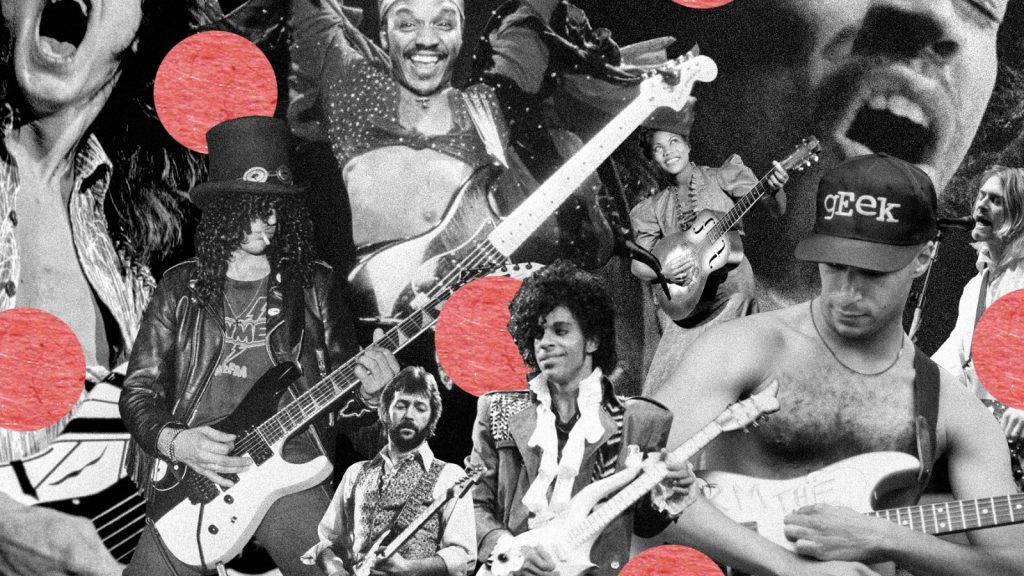
Photographs in Illustration By
Gus Stewart/Redferns/Getty Images; Echoes/Redferns/Getty Images; Evening Standard/Hulton Archive/Getty Images; Larry Marano/Getty Images; James Kriegsmann/Michael Ochs Archives/Getty Images; John Atashian/Getty Images; Chris Walter/WireImage/Getty Images; Richard E. Aaron/Redferns; Gie Knaeps/Getty Images
AC/DC, ‘You Shook Me All Night Long’
Image Credit: Paul Natkin/Getty Images
The giant ringing chords, platonically perfect snare drum sound, and throat-bleeding vocals of “You Shook Me All Night Long” set a daunting standard, but Angus Young manages to somehow take a perfect song even higher with a taut, lascivious, no-note-wasted solo. With its shuddering vibrato, major-minor contrasts, and steady build, it’s a quick, little Ph.D.-level school on the art of rock lead playing, all from a guy in schoolboy shorts. It’s impossible to imagine a change to even a single bend or flourish. Young’s “solos always had a purpose,” Joe Perry once said. “Instead of using all the traditional tricks, he found a way to get inside those licks and be inventive.”—Brian Hiatt
Onstage, Buddy Guy was the first Stratocaster wild man, lacing his manic fretwork with distortion and feedback while Eisenhower was still in the White House. But in the studio, his label, Chess Records, relegated him to session work, urging him to turn down his amp while he was backing Howlin’ Wolf and Muddy Waters, trying to smooth out his sound to the point of suggesting a new name: Buddy King. But in the series of increasingly untamed solos on “Stone Crazy,” cut in late 1961, Guy’s actual sound came to life on tape, even if the full seven-minute version was shelved for nearly a decade. “Stone Crazy” was Hendrix before Hendrix, and it gave Eric Clapton an entire lexicon of licks to skim for Cream. “Somebody come get me,” Guy mutters before one manic flurry of licks — but try as they might, no one ever managed to catch up with him.—B.H.
Geese, ‘Getting Killed’
Image Credit: Griffin Lotz
Sure, enigmatic Geese frontman Cameron Winter gets most of the attention, but the band’s elliptical art-rock epiphanies wouldn’t hit nearly as hard without Emily Green’s guitar playing, especially on “Getting Killed.” The first half of the song is a salvo on all fronts, with each band member attacking their instrument, and then abruptly pivots to a lush and layered solo from Green. Her playing is lithe and spry like Tom Verlaine of Television, but also woozy like mid-career Radiohead, and so well-crafted you can imagine her mapping out every note she plays before she picks a string. “Getting Killed” isn’t flashy or freewheeling, but that’s not the point. Green’s style captivates you with its minimalist flair.—Jaeden Pinder
Megadeth, ‘Hangar 18’
Image Credit: Mick Hutson/Redferns/Getty Images
Using a sophisticated chord sequence he concocted while in Metallica (see: “The Call of Ktulu”), Megadeth singer-guitarist Dave Mustaine laid the foundation for lead guitarist Marty Friedman’s acrobatic fretwork. Friedman had spent the better part of his 20s playing 1,000 notes per second with the shred-metal group Cacophony. But with Megadeth, he could finally consider the music. “[Producer Mike Clink] told me to look at the lyrics, which were about aliens, and try to reflect the subject matter as much as I could in my playing,” Friedman once said. “I’d never cared about lyrics before, so it was a revelation to suddenly have to think hard about making my solos sound like they came from Mars.” Playing jazzy, Middle Eastern-influenced scales with slippery flourishes in between the notes and Mustaine’s own rapid-fire leads, he elevated what would’ve been another thrash goof into high art.—Kory Grow
Red Hot Chili Peppers, ‘Scar Tissue’
Image Credit: Frank Micelotta/ImageDirect/Getty Images
When the first single arrived from the Red Hot Chili Peppers’ 1999 album, Californication, fans weren’t sure what to expect. It had been a long four years since their last album, 1995’s One Hot Minute, a psych-funk stomper that failed to continue the momentum of 1991’s Blood Sugar Sex Magik. A big reason for that was the absence of guitarist John Frusciante, who had been replaced by Jane’s Addiction’s Dave Navarro. But now Frusciante was back, and all doubts were laid to rest on “Scar Tissue,” a blissfully beautiful welcome-home party that’s still the most mellow these guys have ever sounded. Using a slide on a 1960s custom Fender Telecaster, Frusciante lays down a solo that melts each note so that it flows like one long, groovy river. It was the start of a whole new era for the band. —Angie Martroccio
Les Paul and Mary Ford, ‘How High the Moon’
Image Credit: Express/Getty Images
You can essentially chart the history of the electric guitar as Before Les Paul and After Les Paul. The musician had been messing around with customizing his own electric six-string for years when he finally developed what would become his signature solid-body guitar — and nowhere is Paul’s influence on how that instrument could be played better heard than on this cover of the Morgan Lewis and Nancy Hamilton standard. The song had been part of the repertoire of Paul’s trio in the 1940s, but when he and his wife, Mary Ford, cut their Western-swing version of the track in their home studio in Queens, he sped up the tempo and seriously ramped up the solo. Everything chugs along nicely as Paul picks out what sounds like a Django Reinhardt line until right before the song’s minute mark — and then our man simply lets loose. The violent strums and sustained notes seem to echo decades into the future. —David Fear
Smashing Pumpkins, ‘Mayonaise’
Image Credit: Gie Knaeps/Getty Images
Billy Corgan drew directly from the classic rock that shaped him — Iron Maiden’s harmonized dual-lead runs, Pink Floyd’s atmospheric slow-burn climaxes, Jimmy Page’s intricately-layered soundscapes — and supersized his ambitions via lavish production and a total absence of modesty. Yet the comparatively restrained solo on “Mayonaise,” tucked between the face-melting freakouts of “Geek U.S.A.” and “Silverfuck” on Smashing Pumpkins’ 1993 masterpiece, Siamese Dream, hits the hardest because of its vulnerability. Corgan does nothing by accident, so it likely took careful construction to make something that sounds like it’s falling apart. From the trembling sustained note that feeds back erratically to the aching bends on the verge of cracking, Corgan sets a template for the grand, distorted, beautifully wounded sound of nascent Nineties alt-rock.—Jason Roth
The Commodores, ‘Easy’
Image Credit: Hulton Archive/Getty Images
The Commodores’ Seventies classic “Easy” might sound silky smooth, but its snapping, melodic guitar solo illuminates the tensions in its lyrics. The man who made it happen is Thomas McClary, who wrote or co-wrote many of the group’s hits and played a huge role in shaping their unique mix of soul, funk, country, and gospel. “When you have lyrics in a song that say, ‘Why in the world would anybody put chains on me? I’ve paid my dues to make it,’ you have to match the intensity of those lyrics,” McClary said of “Easy” in a 2017 interview. “A lot of ballads, the song would just end, but we wanted the guitar solo to take it to another level of intensity.”—Maura Johnston
With his band Pavement, Stephen Malkmus was the flippant Nineties indie jester, with a bratty love for art-damaged punk feedback. But the Northern California boy soon revealed himself as the shaggiest of shredders. He explores his gorgeously lyrical solos all over indie-rock classics like Pavement’s Brighten the Corners (“Fin”), Silver Jews’ American Water (“Night Society”), or his solo records with the Jicks, like Pig Lib and Real Emotional Trash. The recent Pavement reunion tours were so jammed-out, he introduced the band as “Phishport Convention.” But he’s never reached higher than “Share the Red,” from 2011’s Mirror Traffic, two decades into his career. It’s a wistful ballad of feeling lost in adulthood (“Forty with a kid/Living on the grid”), but Malkmus lets his guitar tell most of the story, with elegiac hippie ripples full of mellow Seventies soft-rock gold-soundz. It’s the most beautifully unguarded and soulful playing of his life — so far. —R.S.
Aerosmith, ‘Walk This Way’
Image Credit: Richard E. Aaron/Redferns/Getty Images
While this deeply horny cut from Aerosmith’s 1975 landmark, Toys in the Attic, is best known for its funk-tinged central riff, guitarist Joe Perry’s showy solos give Steven Tyler’s flirtations a playful edge. After Tyler’s first plea to “just give me a kiss,” Perry offers a taste of his virtuosity with a squealing solo that, according to Guitar World, he overdubbed using a double-cutaway Gibson Les Paul Junior with a single P-90 pickup; after the second go-round he played a late-Fifties model Stratocaster that he also used on his final showcase, a lengthy solo that veers back and forth between longing squeals and fast-fingered blues jamming.—M.J.
Paul Butterfield Blues Band, ‘East-West’
Image Credit: Don Paulsen/Michael Ochs Archives/Getty Images
In late 1965, Michael Bloomfield stayed up all night on acid listening to Indian sitar music. He emerged with “East-West,” the 13-minute psychedelic jam that blew minds in the summer of 1966, mixing up modal jazz, raga drones, and Chicago blues into a new breed of screaming rock monster. He was already a top guitarist — that’s him all over Bob Dylan’s Highway 61 Revisited. But “East-West” is his timeless visionary trip — “a different kind of blues,” Carlos Santana called it. The Butterfield Blues Band would improvise on it for a half-hour or more live. “Pre-‘East-West,’ I was listening to a lot of Coltrane, a lot of Ravi Shankar, and guys that played modal music,” Bloomfield said. But for bands like the Grateful Dead, Santana, and Quicksilver Messenger Service, it was a door into the future. “We were all just awestruck,” the Dead’s Bob Weir recalled. “Within about six months everybody copped all his licks.”—R.S.
Gerry Rafferty, ‘Baker Street’
Image Credit: Gie Knaeps/Getty Images
Scottish bard Gerry Rafferty’s “Baker Street” is one of the most iconic moments in soft-rock history, a Number Two hit in 1978 that continues to occupy a preeminent place in today’s yacht-rock canon. For its guitar solo, session vet High Burns was saddled with the tough job of coming up with something that might match the grandeur of Raphael Ravenscroft’s towering sax solo, and he nailed it with a soaring, crystalline performance that perfectly echoes the mood of the sax. Burns has enjoyed a huge career as a studio great, including work with Paul McCartney and George Michael, who he backed on “Careless Whisper.”—J.D.
Genesis, ‘Firth of Fifth’
Image Credit: Ian Dickson/Redferns/Getty Images
Like many of the best early Genesis songs, the prog-rock epic “Firth of Fifth” was largely written by keyboardist Tony Banks. And he originally planned on wrapping up the nearly 10-minute epic with a keyboard solo. “But then I started playing it on electric guitar,” guitarist Steve Hackett told Rolling Stone in 2019. “It happened to work particularly well with the pedal I had and the fuzzbox I had back in the day … it was a particularly good melody played on guitar. Played on piano, it sounds like a French Impressionistic thing. But when played on guitar, it’s got something Egyptian or Middle Eastern. Once I started playing it on guitar, Tony was like, ‘Oh, let’s do it as a band. Let’s do it with big keyboards.’” It was a fortuitous decision that gave Hackett a signature solo he continues to play at theaters all across the globe to adoring fans. —Andy Greene
Girlschool, ‘C’mon Let’s Go’
Image Credit: Donna Santisi/Redferns/Getty Images
Kelly Johnson played guitar in the all-female band Girlschool, part of the New Wave of British Heavy Metal that also produced Iron Maiden and Motörhead, who Girlschool teamed up with in 1981 for the Valentine’s Day Massacre EP. “Kelly Johnson, on a good day, is as good as Jeff Beck in his rock & roll days,” said Motörhead’s Lemmy. Johnson was as good as any other Eighties shredder at mixing punk aggression, blues-rock grind, and metal flash on songs like “Yeah Right, “Hit and Run,” and, especially, “C’mon Let’s Go,” the opening track on the band’s great album Hit and Run. On “C’mon Let’s Go,” she gets in and out quick, packing scads of weapons-grade shredding into compact package.—J.D.
Pantera, ‘Cemetery Gates’
Image Credit: Mick Hutson/Redferns/Getty Images
Beyond the tragic circumstances of his 2004 death, Dimebag Darrell’s true legacy lies in his unique ability to combine flash and feel — where dazzling technique meets raw emotion — without sacrificing power on either side. At a time when hair metal and hyper-speed thrash ruled the land, his playing on 1990’s “Cemetery Gates” helped to define an emerging “groove metal” scene that was less frenetic, more inward-looking, and viewed guitars as potential storytelling tools rather than just blunt weapons. In the soaring solo, Darrell sonically helps to tell the song’s story of grief and loss in three distinct acts. First, a melancholic passage of vocal-like bends that counter Phil Anselmo’s guttural growls. Then, a furious, tension-building climb of breakneck runs and harmonic squeals. And finally, a cathartic, high-register release that wrings every ounce of drama from the moment.—J.R.
John Mayer, ‘Gravity’
Image Credit: Amanda Edwards/Getty Images
A standout track on the aptly named album Continuum, Mayer’s maturing sound was informed by his own guitar hero, Stevie Ray Vaughan, and by touring and recording with the blues-based John Mayer Trio. “Gravity,” which the voluble Mayer has described as “the most important song I’ve ever written … [with] the fewest words,” and its deceptively straightforward solo, is a study in negative space, gently swooping and surging, with moments of silence baked in like glimmers of sun through the trees on a late summer evening. Some players rely on loud amps or effects to get the tone across, but it’s all about the fingers here (a skill Mayer would hone further during his decade-long run in Dead & Company, where he was tasked with the solo work). There’s no bluster or bravado to offset the stillness of “Gravity” in its recorded version. A live take released in 2008 (paired with Otis Redding’s “I’ve Got Dreams to Remember”) bends even more at nearly 10 glorious minutes.–Shirley Halperin
Pearl Jam, ‘Alive’
Image Credit: Steve Eichner/WireImage
When Mike McCready first met up with Mother Love Bone’s Stone Gossard and Jeff Ament — before Eddie Vedder entered the picture — they played him a rough track titled “Dollar Short.” “I remember hearing it, thinking, ‘OK, this is cool. What can I do with this,’” McCready recalled in 2024. “The pattern led me to playing the Ace Frehley ‘She’ solo, which I later found out was the Robby Krieger ‘Five to One’ solo.’” The influence of Frehley and Krieger is clear on the solo he eventually composed, but he turned it into something distinctly his own. And once Vedder put hit lyrics on top of it and called the song “Alive,” Pearl Jam were born.—A.G.
Talking Heads, ‘Born Under Punches (The Heat Goes On)’
Adrian Belew’s otherworldly guitar playing made him a highly sought-after musician in the Seventies and Eighties, including gigs with King Crimson, Frank Zappa, and David Bowie. He was especially interested in creating sounds that didn’t seem like they were coming from a guitar at all, and he really outdid himself on Talking Heads’ 1980 masterpiece, Remain in Light, especially its opener, “Born Under Punches (The Heat Goes On).” Against a dense, frenetically funky track, he used an arsenal of gear to create elliptical blips that sounded like a dial-up modem gone nuts or an interplanetary distress signal. “I recorded a guitar solo and then ran it through an expensive piece of studio gear called a Lexicon Prime Time,” he revealed years later, “which allowed me to alter the [bandwidth] of the sound while capturing quick little loops I could fool with.”—J.D.
Richard and Linda Thompson, ‘The Calvary Cross’ (Live at the Oxford Polytechnic)
Image Credit: David Redfern/Redferns/Getty Images
“I took up music,” Richard Thompson once told Rolling Stone, “so I wouldn’t have to talk to people.” He’s always reigned as the guitar hero of British folk rock, ever since his Sixties band Fairport Convention, with morbid classics like “Sloth” and “Meet on the Ledge.” For him, folk music was the dark stuff. “There’s more murder in it, more death, more of the supernatural, and more industrial grit.” But this live version of “The Calvary Cross” is his peak, a 13-minute Stratocaster seance full of late-night Celtic dread. It’s from his Oxford Polytechnic show on Nov. 27, 1975 — one of the great evenings in six-string history. (Don’t get us started about “Night Comes In” from the same gig — both are on the essential Guitar, Vocal.) His shivery tremolo solo is haunted by accordion, wife Linda Thompson’s harmonies, and an ancient sense of doom, casting a unique spell.—R.S.
MJ Lenderman, ‘Knockin’’
Image Credit: Griffin Lotz for Rolling Stone
For many listeners, North Carolina singer-songwriter MJ Lenderman’s sad-guy musings have practically made him the poet laureate of 2020s indie rock. As a guitarist, he’s a brilliant inheritor of aching-noise greats like Neil Young and J Mascis. On “Knockin’,” he weaves together scenes of twentysomething ennui and delivers a knockout punch with a guitar part that distills heartbreak and loneliness in sonic form. When Lenderman launches into his solo, he stretches it out like taffy, making each note feel as enveloping as the embrace his character pines for throughout the track.—J.P.
Steve Vai, ‘For the Love of God’
Image Credit: Frans Schellekens/Redferns/Getty Images
When Steve Vai released Passion and Warfare in 1990, he had played with Frank Zappa, filled the unimaginably large shoes of Eddie Van Halen in David Lee Roth’s post-Van Halen group, faced off with Ralph Macchio in the hit 1986 film Crossroads, and recorded and toured with mega-platinum hard-rock veterans Whitesnake. Given Vai’s high profile, it’s not surprising that Passion and Warfare, albeit largely instrumental, entered the albums chart in the Top 20. The epic “For the Love of God”vividly illustrates that Vai wasn’t just at the height of his visibility, he was also at the apex of his creative powers. The six-minute track sees him exploring the song’s languid theme at length before falling into a fever dream where bizarre whammy-bar warbles punctuate angular phrases, flurries of tremolo-picked notes peel from the speakers, and descending legato runs eventually return Vai (and the listener) to waking reality. —Tom Beaujour
Yes, ‘Starship Trooper’
Image Credit: Michael Putland/Getty Images
A couple of years before Steve Howe joined Yes, he was in the struggling British rock band Bodast. The group is little more than a footnote today, but its song “Nether Street” — written entirely by Howe — provided the framework for the third section of “Starship Trooper” on 1971’s The Yes Album. Once Howe was working alongside true visionaries like bassist Chris Squire, drummer Bill Bruford, and singer John Anderson, his guitar solo at the end took off like a starship entering the cosmos. It was prog-rock fans’ first glimpse at Howe’s genius. All these years later, Howe is the only classic-era member of Yes still in the band. Nearly every show ends with “Starship Trooper,” and the solo never fails to bring the entire crowd to their feet. It’s prog-rock at its most majestic.—A.G.
Judas Priest, ‘Painkiller’
Image Credit: Mick Hutson/Redferns/Getty Images
The double-bass-drum-powered riffs and breakneck tempos of Judas Priest’s 1990 album, Painkiller, proved the veteran metal band was still a force to be reckoned with. Hungry to establish their relevance in a world dominated by a new generation of young-gun shredders, guitarists Glenn Tipton and K.K. Downing clearly logged serious time in the woodshed before laying down the solos for Painkiller’s unrelenting title track. Tipton takes the tune’s main (and most frequently dissected) solo, bursting off the starting blocks with a flurry of sweeping notes before throttling his whammy bar, nailing a sequence of hammer-on arpeggios and speed-picking his way to the finish line. Downing, whose style is more aggressive than technical, closes the song with a blues-based burst of notes that incorporates dive bombs and squealing pick harmonics to devastating effect.—T.B.
Albert King, ‘Crosscut Saw’
Image Credit: Michael Ochs Archives/Getty Images
“My music is different from any blues player you hear,” Albert King declared late in his career. “I guess it’s because I’m wrong-handed.” The blues pioneer was a massive man with giant hands, a leftie playing his right-handed Flying V upside down, never using a pick. He grew up on a Mississippi Delta plantation with no electricity, teaching himself to play on a cigar box — “I rehearsed to myself seven years before I played with anybody” — yet became one of the most influential blues legends. As Gregg Allman said, “I don’t know a guitar player alive who didn’t cut their teeth on Albert.” The Stax hit “Crosscut Saw” showcases the Velvet Bulldozer’s string-bending power, cut in Memphis with Booker T. and the MG’s. “This gives me goosebumps,” Rush’s Alex Lifeson told Rolling Stone of this solo. “It’s all feel. His vibrato. The way he plays the notes. How he chokes them out.”—R.S.
Jimmy Eat World, ‘The Middle’
Image Credit: Martyn Goodacre/Getty Images
With “The Middle,” Jimmy Eat World delivered an emo anthem with rock & roll flash. On the song’s solo, Jim Adkins dances across the frets of his signature Fender Telecaster, adding a twangy edge that could be heard as a nod to the Arizona band’s Southwestern roots. Adkins credits Guided by Voices guitarist Doug Gillard and the “hammer-on, pull-off elements” he brought to the indie-rock heroes’ 1997 tune “I Am a Tree” as the inspiration for the solo’s distinct jangle. “For some reason, I thought of that,” he toldEntertainment Weekly back in 2021. In the same interview, Adkins revealed that the song almost didn’t have a solo: “I don’t think there was a guitar solo on the original demo … The solo wasn’t final until we got into the studio.” —M.G.
The Cars, ‘Just What I Needed’
Image Credit: Ron Pownall/Getty Images
“The odds of me winging a solo that’s gonna be better than one I sat and worked really hard on,” Elliot Easton once told Guitar Player, “are very slim.” That philosophy produced one of the most hummable guitar solos ever recorded, composed like a pop song in its own right and refined through a year of club gigs. By the time the Cars hit AIR Studios in London with producer Roy Thomas Baker, every note was locked, with Easton steering through the chord changes, jazz-style, instead of spamming through pentatonic licks. Baker double-tracked it at slightly different tape speeds, giving it a shimmer everyone still mistakes for a chorus pedal. Ric Ocasek never wanted Easton to be marketed as a guitar hero, but the kids who still try to learn this solo note for note knows that he deserved to be.—B.H.
Sleater-Kinney, ‘Let’s Call It Love’
Image Credit: Jana Birchum/Getty Images
Sleater-Kinney have always kept finding ways to shake up rock cliches. They started as a scrappy bash-it-out punk trio, raging in the Olympia, Washington, riot grrrl scene, but evolved into a fearsome rock & roll machine on albums like Dig Me Out. Carrie Brownstein revels in her guitar-hero moves, priding herself on being one of the few players who can pull off a Pete Townshend-style windmill. Yet she, Corin Tucker, and Janet Weiss really took it to extremes with the stretched-out live jam that finally made it to The Woods as the 11-minute blowout “Let’s Call It Love.” She shreds with no mercy on her Gibson SG. “It’s a demon guitar,” she told Marc Maron on WTF. “I like a guitar that has a little bit of growliness to it — one that feels like the harder you play, it will react to that.”—R.S.
Dale Hawkins, ‘Susie-Q’
Image Credit: ABC Photo Archives/Disney General Entertainment Content/Getty Images
Fifteen-year-old Louisiana guitar prodigy James Burton came up with the riff while messing around with a slinky, swampy lick he’d developed by playing both the bass line and the lead melody simultaneously while snapping the strings of his Telecaster for a percussive thump. It caught the ear of his then-bandmate Dale Hawkins, who shaped the riff into a proper song with lyrics inspired by a local crush. When Hawkins released “Susie Q” in 1957, Burton’s name was nowhere to be found, and he unjustly never received songwriting credit or royalties. However, it’s his economical but hypnotic solo — a gumbo of country, blues, and rockabilly steeped in Louisiana’s cultural melting pot — that helped to make the song an early rock & roll classic, a blueprint for “swamp rock,” and Creedence Clearwater Revival’s first hit single when they covered it in 1968.—J.R.
The Knack, ‘My Sharona’
Image Credit: Michael Ochs Archives/Getty Images
Never has a guitar solo — arguably even an entire song — been done so wrong by a single edit. The version of the Knack’s “My Sharona” that you’ve likely been hearing on the radio since 1979 boasts a criminally truncated version of Berton Averre’s solo — just 39 seconds, enough to shoot off a few fireworks, before the show awkwardly ends. The full version, however, rages for a minute-and-a-half. It’s a delirious display of power-pop pyrotechnics, full of fervent finger-tapping, bent-string belting, and licks that skitter between notes like a decibel meter flickering in the red. These are all classic guitar tricks, but as Averre shows, there’s nothing wrong with the classics. His delivery is dynamic, and his execution exceptional. Some might think a 90-second solo for a pop-rock hit is indulgent, but Averre earns every moment.—Jon Blistein
Yeah Yeah Yeahs, ‘Maps’
Image Credit: Theo Wargo/WireImage
The song that propelled Yeah Yeah Yeahs from sweaty New York clubs to alt-rock radio is a gorgeous ballad that, according to lead singer Karen O, took 20 minutes to write. Guitarist Nick Zinner’s solo blows the spectral track wide open; deceptively simple in melodic structure, it’s remarkable for the way Zinner fully leans into it, his formidable tone adding an emotional wallop to the already pretty devastating proceedings. It also had wider ramifications in pop: Max Martin and Dr. Luke lifted Zinner’s solo nearly wholesale for the breakdown of Kelly Clarkson’s 2004 megahit “Since U Been Gone,” a rip so obvious it inspired blends of the two. “You know, I can’t say that the word lawsuit hasn’t crossed my mind, but at the same time … I don’t know,” Zinner told Gothamist in 2006. “The YYYs have definitely stolen stuff before … so I guess it’s karmic.”—M.J.
Nirvana, ‘Heart-Shaped Box’
Image Credit: Jeff Kravitz/FilmMagic
“Heart-Shaped Box” is a direct representation of Kurt Cobain’s psyche, with imagery of meat-eating orchids and umbilical cords as nooses (the title was inspired by an actual heart-shaped box his wife, Courtney Love, had gifted him, while the line “Forever in debt to your priceless advice” derives from a letter Cobain had written her). The solo itself has a journey of its own: After noise-rock stalwart Steve Albini produced In Utero, R.E.M. producer Scott Litt was enlisted to remix “Heart-Shaped Box” and “All Apologies.” Litt’s commercial-friendly reworking removed the buzzy guitar effect on the solo, resulting in a cleaner, more concise pocket of fuzzed-out glory. But if you want a happy medium of the two, check out Nirvana’s early live renditions of it, like their January 1993 performance in Rio de Janeiro — blistering and blissful, all at once.—A.M.
Frank Zappa, ‘Watermelon in Easter Hay’
Image Credit: Richard E. Aaron/Redferns/Getty Images
Frank Zappa had a strange relationship with guitar solos. When he hit his stride on fiery, impossible-to-replicate six-string showcases like “Black Napkins,” his guitar stuttered, yammered, and hiccupped over loping rhythms, and on songs like “Sleep Dirt,” it sounded like the instrument was melting into a bluesy puddle. “Watermelon in Easter Hay,” however, is Zappa at his most traditional: a weepy, humanistic meditation over New Age-y chord changes in 9/4 time. In the Joe’s Garage rock opera, it’s Joe’s last imaginary guitar solo before he gives up on the music industry, and you can feel that pain come through in Zappa’s playing. “It’s the best song on the album,” Zappa himself once contended, and it got better live. The lengthy version on the Halloween ’78 bootleg, on which Zappa trades solos with violinist L. Shankar, is simply jaw-dropping.—K.G.
Iron Maiden, ‘The Trooper’
Image Credit: Paul Natkin/Getty Images
Although Iron Maiden’s use of galloping rhythms is so pervasive as to be considered proprietary in heavy metal circles, it is uniquely effective in “The Trooper,” a track from the band’s fourth album, Piece of Mind. Guitarists Adrian Smith and Dave Murray spearhead the attack with their tightly harmonized riffs and trills. Smith takes the song’s first solo break, segueing from wide, bugle-like bends into a deadly succession of blues and minor arpeggio speed licks that he concludes with a triplet scale run. One can almost imagine him and his steed being obliterated by enemy shells and Murray bravely grabbing the standard to continue the fight. His weapons of choice: rapid-fire trills, a wailing tremolo-arm drop, and a few well-placed blues licks that use pre-bending to keep the listener guessing.—T.B.
Helium, ‘XXX’
Image Credit: Steve Eichner/WireImage
Mary Timony grew up as a classically trained shredder, from the Satriani/Vai school — but she took all that technique to play in the D.C. hardcore scene. “People would assume I was a girlfriend of the band,” she said in 1995. “That might be why I use music in a revengeful way.” She’s made her eccentric noise with her indie bands Helium, Wild Flag, and Ex Hex, swerving between punk and prog. As Snail Mail’s Lindsey Jordan — one of her guitar students — said, “Everybody wants to be her.” “XXX” is a wild nightmare from Helium’s 1994 debut, Pirate Prude, with abrasively funny menace in the violent clang. “I was in this phase in my music where I wanted to unlearn everything,” Timony said in 2017. “I would play stuff with one finger, bend the strings, detune a lot.” For her, “XXX” was “me almost fighting with the guitar.” It’s a powerfully cathartic sound.—R.S.
King Sunny Ade, ‘Sunny Ti Die’
Image Credit: Paul Natkin/Getty Images
King Sunny Ade reigned in his native Nigeria as the master of juju music, before the rest of the world caught on. His 17-piece band the African Beats were legendary for marathon gigs lasting up to eight hours. But he blew up worldwide in the Eighties, with his polyrhythmic Yoruba style, letting his guitar do the talking. No African musician had ever made such a global splash, influencing bands from Talking Heads to Phish, along with future Afrobeats stars like WizKid. “Juju music, way back in the early Twenties, was built up from the music played in shrines,” Ade toldRolling Stone in 1983. The King recorded “Sunny Ti De” repeatedly over the years, but the definitive 1974 version (reissued on The Best of the Classic Years) is the ultimate showcase for his hypnotic guitar twang, echoing over the talking drums. “I have my own vision,” Ade said. “Pushing love and peace.”—R.S.
Dick Dale and the Del-Tones, ‘Misirlou’
Image Credit: Michael Ochs Archives/Getty Images
Dick Dale’s iconic surf-guitar instrumental “Misirlou” doesn’t contain a designated solo as much as it is one sustained, self-contained solo: a nonstop attack of blisteringly fast tremolo picking, exotic-sounding Middle Eastern scales, and heavy-duty reverb. The song, whose author remains unknown, was first recorded by Greek folk musicians in the 1920s and popularized through interpretations across Arab countries, before Dale’s souped-up surf-rock version brought it to Western ears in 1962, and Quentin Tarantino made it forever synonymous with cinematic retro cool as the soundtrack to the opening sequence of Pulp Fiction. Dale’s version is pure adrenaline from the get-go: a relentless hornet’s nest of rhythmic propulsion and raw amplification — no verse, no chorus, no words, just pure chaotic release courtesy of Dale’s customized gold Stratocaster, appropriately nicknamed “The Beast.”—J.R.
Radiohead, ‘Paranoid Android’
Image Credit: Mick Hutson/Redferns/Getty Images
If you think a six-and-a-half minute single is long, keep in mind that the original version of “Paranoid Android” was roughly twice that length. “It originally had a Hammond organ solo that goes on forever,” guitarist Johnny Greenwood told us in 2017. “It’s hard to listen to without clutching the sofa for support.” The organ portion was eventually replaced with a shorter guitar solo, but thankfully it doesn’t diminish the OK Computer highlight’s prog-rock ambition. Greenwood still tears it up on a Fender Telecaster Plus, delivering a turbulent, unpredictable frenzy of notes that matches the song’s themes: disgust with consumerism, politics, and modern alienation at its finest. —A.M.
Boston, ‘More Than a Feeling’
Image Credit: Ebet Roberts/Getty Images
“More Than a Feeling” is more than a Seventies rock anthem — it’s a cathedral. The band Boston were the brainchild of MIT-educated Polaroid engineer Tom Scholz, a gear head tinkering in his home-studio laboratory. But he turned his technocrat style into a majestic arena banger. It modulates from acoustic proto-R.E.M. beauty to that proto-Nirvana air-guitar riff, but it’s the solo that captures the song’s raw emotion. Scholz builds it into a sonic shrine of guitar worship, with a celestial sheen in the spirit of Pet Sounds. Brad Delp sings about hiding away in his music, dreaming of the Marianne who keeps walking away. Critic Greil Marcus summed it up perfectly: “an undeniable insistence on the grandeur of the pain and longing of even the most ordinary young men.” As Scholz told Rolling Stone’s Cameron Crowe, his model for the solo was the Tornados’ 1960s space-pop oddity “Telstar,” but “only two people noticed that.”—R.S.
Eric Johnson, ‘Cliffs of Dover’
Image Credit: Gary Null/NBCU Photo Bank/NBCUniversal/Getty Images
Although it had been a staple of his live set for years — a live rendition of the instrumental was even included in a 1986 issue of Guitar Player magazine as a flexi-disc — it’s the version of “Cliffs of Dover” that appears on Eric Johnson’s 1990 platinum-selling Ah Via Musicom that earned him a Grammy and secured his place in the guitar-god firmament. The track, which Johnson told Guitar World magazine “came together in five minutes — I was just connecting the dots,” turns traditional song structure on its head by starting with what has come to be regarded as the song’s most notable lead section. Performed in free time before the band kicks into an up-tempo shuffle, the richly overdriven intro melds soaring bends, cascading sixteenth-note pentatonic patterns, and lightning-quick, violin-inspired pedal tones into 25 seconds so jam-packed with fresh sounds and techniques that scores of guitarists have built entire careers out of recycling its licks.—T.B.
Boris, ‘Naki Kyoku’
Image Credit: Paul Natkin/Getty Images
Wata has described Boris as “extreme healing music,” with cathartic beauty in the turmoil. Growing up in Hiroshima, she took piano lessons before turning to the guitar at 16, inspired by Pink Floyd’s Live at Pompeii. But she’s the avant-noise guitar master in the experimental Japanese metal trio Boris, with a prolific run of massively influential classics like Feedbacker and Pink, mixing up sludge metal with psychedelic rock, shoegaze, and drone doom. “Naki Kyoku” is her elegiac masterpiece, from the 2003 gem Akuma No Uta, a slow-burning, 12-minute requiem that translates as “Nothingness Song.” She begins with a gently mournful intro for the first couple of minutes, before exploding into her full-on brain-melting attack, with her 1986 black Les Paul roaring through her Matamp and Orange amps. As she says, “Take the feelings that have not yet become emotions, before they become emotions, and translate them into music.”—R.S.
Blue Öyster Cult, ‘(Don’t Fear) The Reaper’
Image Credit: Michael Putland/Getty Images
The spooky opening riff to Blue Öyster Cult’s ode to Romeo and Juliet and death and love is legendary, still one of the most immediately recognizable moments on classic rock radio. Yet, it’s merely a prelude to the solo, played in one possessed take by the song’s writer and lead vocalist, Buck Dharma. “(Don’t Fear) The Reaper” builds tension for two and a half haunting minutes and then stops abruptly, followed by a solo at once precisely orchestrated, operatically explosive, and downright chilling — not just a moment of diabolical studio execution but high drama as well, perfectly embodying a sense of terror that up to then had only been suggested in the music. Heard under the right circumstances (a backyard tent sleepover listening to the radio in 1976, perhaps) it might make you think the reaper was coming for you too.—J.D.
The Pretenders, ‘Tattooed Love Boys’
Image Credit: David Warner Ellis/Redferns/Getty Images
Emerging from the flameout that was U.K. punk’s ascension, James Honeyman-Scott’s fretwork on the Pretenders’ 1980 debut album is a blistering, fragmented hopscotch of guitar-hero moves culminating in a stroboscopic montage of a solo. Cobbled together in the hallway just before recording, the ensuing high-wire dramatics — complete with sputtering bridge — burn all paths to the past while matching singer Chrissie Hynde snarl for snarl. Honeyman-Scott, who died of a drug overdose in 1982, took a punk attitude toward his guitar solos. “I hate soloing, really,” he said in 1981. “I like to do something that you’d end up whistling. Something short.”—S.H.
Deep Purple, ‘Highway Star’
Image Credit: David Warner Ellis/Redferns/Hulton Archive/Getty Images
Ritchie Blackmore’s lead break on “Highway Star” starts off as a slightly off-kilter jazz figure before building into a soulful lyrical phrase and then exploding into a fugue of triplets that sounds more like Bach than the blues. It gave the song a sense of melody in ways that frontman Ian Gillan couldn’t. The guitarist has always said that even though hard rock is essentially blues-derived music, he drew more inspiration from classical music than the blues, and the novelty of using full harmonic scales instead of only pentatonic scales set Deep Purple apart from their proto-metal peers in Led Zeppelin and Black Sabbath, and it paved the way for guitarists like Randy Rhoads and Yngwie Malmsteen, who were also well studied in the classics.—K.G.
Robert Fripp was feeling frustrated by the intra-band dynamics in King Crimson when Brian Eno invited him to play on his 1974 solo debut, Here Come the Warm Jets. You can hear that aggravation in the needling scream of a guitar solo he ripped for this song, delivering three minutes of pissed-off instrumental wizardry. “I’d just gotten off a plane from America,” Fripp later said. “I had the flu. I was exhausted. I was wretched, and yet the solo was burning. It doesn’t matter how you feel.” Fripp and Eno had begun collaborating two years earlier on the ambient landmark No Pussyfooting, using delayed tape loops to create the searing, spacious “Frippertronics” sound that Fripp went on to bring to albums by David Bowie, the Roches, and others. But this solo remains one of the most memorable high points of their work together. —Simon Vozick-Levinson
Link Wray, ‘Rumble’
Image Credit: David Warner Ellis/Redferns/Getty Images
From Link Wray’s first strummed chord, 1958’s “Rumble” sounds like a street fight just waiting to happen, and a dirty one at that. Which is why, according to lore, the distortion-heavy instrumental was banned from radio play. These days, it’s enshrined in both the Rock & Roll Hall of Fame and the Library of Congress, and it is regarded as the big bang of the power chord. According to Wray, the song actually was inspired by a brawl. “It was a little instrumental I did when I was doing record hops with a TV disc jockey in D.C.,” he said in a 1984 interview. “A fight broke out, and I started playing an instrumental to the fight. Everybody started saying, ‘Hey man, play that song again.’ But I didn’t know what I was doing, I was just making fun of the fight.”—Joseph Hudak
Dinosaur Jr., ‘Freak Scene’
Image Credit: Mick Hutson/Redferns/Getty Images
Dinosaur Jr. dropped “Freak Scene” in 1988, before the terms “alternative” and “grunge” were associated with music. But it was a big step away from the band’s low-fi roots, toward the more accessible records they’d release in the 1990s. And the greatness of the band in any era is captured in the guitar solo, a wild fusion of Neil Young and Kevin Shields that pours off the fingers of J Mascis. Just about the only person unimpressed, at least at first, was Dinosaur Jr. bassist Lou Barlow, who left the band soon after the song hit. “My first impression was, ‘Wow, J’s aiming real low with this one,’” Barlow said in 2025. “I usually wasn’t critical of his songwriting, as I kind of worshipped his ability, but it was very simple compared to these instrumental epics that he was coming up with.”—A.G.
Freddie King, ‘Going Down’
Image Credit: Jorgen Angel/Redferns/Getty Images
While the other two Kings of blues guitar, Albert and B.B., came from the Mississippi Delta, Freddie King grew up hundreds of miles away in East Texas. But like the other two, he idolized his fellow Texan T-Bone Walker and devised his own massively influential bent-note sound. Freddie had a string of 1960s classics like “Hideaway” and “The Stumble,” worshipped by young English disciples like Eric Clapton, who always called King his original guitar god. But the Texas Cannonball hit new heights with “Going Down,” with pianist Leon Russell — his solo is the essence of pure blues swagger. It became Kenny Powers’ theme in Eastbound and Down. Even cooler, it was John Bonham’s favorite song, which says it all. “My father would always play Freddie King, ‘Going Down,’” Jason Bonham once recalled, “to the amount that it would be really annoying. If I’ve heard that song once, I’ve heard it a million times.”—R.S.
Mdou Moctar, ‘Afrique Victime’
Image Credit: Paul Bergen/Redferns/Getty Images
Equally inspired by Eddie Van Halen as he is by the Tuareg guitarists of his native Niger, Mdou Moctar is one of the 21st century’s greatest guitarists — and his hypnotizing solo on the desert blues track “Afrique Victime” is a perfect example why. Across the song’s seven-minute run time, the tempo rises and rises as Moctar laments French colonialism’s eternal scar on Niger. By the time he breaks into his solo, it feels like you’re flying warp speed into the desert sun. He plays his solo as if he was vehemently typing away on a computer, sliding back and forth and drumming along the strings, warping the instrument’s tones to mimic a wailing siren. The solo on “Afrique Victime”’ is frenetic yet liberating — it’s no wonder he’s often called the Hendrix of the Sahara.—J.P.
Fleetwood Mac, ‘Albatross’
Image Credit: Michael Putland/Getty Images
Peter Green was the doomed guitar genius of Fleetwood Mac, long before the days of Stevie Nicks and Lindsey Buckingham. He exploded out of the London blues scene, with the smoldering ache of “Man of the World” and “Love That Burns.” His moody space-surf fantasia “Albatross” hit Number One in the U.K. — so great the Beatles copped it for Abbey Road, turning it into “Sun King.” Green had a unique tone — he accidentally put the pickup on his 1959 Les Paul Standard backward, but kept it because he loved the sound. (His guitar now belongs to superfan Kirk Hammett.) But at his peak, he had a tragic LSD-related breakdown and disappeared. By the time his old band rebounded with Rumours, he was sleeping on the streets. “The guitar used to speak for me, but I can’t let it do that for me anymore,” Green said in the docMan of the World. “I can’t let it break my heart again.”—R.S.
The Byrds, ‘Eight Miles High’
Image Credit: CBS/Getty Images
“It was our attempt to play jazz,” Roger McGuinn said of “Eight Miles High.” In 1966, that was a radical idea, and inspired by John Coltrane’s saxophone spirituals and sitar great Ravi Shankar, the Byrds went straight into the stratosphere. The lyrics are about flying in a plane over London (or are they?), the vocal harmonies are beautifully eerie, and McGuinn’s electric 12-string solo is a perfect statement of mind-warped possibility, rivulets of notes flowing and clustering and breaking apart, designed to mimic the feel of Coltrane’s sax playing. “The continuous flow of air in a saxophone with the valves cutting it off is what I was doing with the sustain,” he said later, ”and making short, clicking kind of notes on the break.”—J.D.



A Fan Tours New Jersey’s Bruce Springsteen Center for American Music
They’re not supposed to make a museum about the people you idolized in high school....
Diane Warren Pens Heartfelt Tribute to Clive Davis
Diane Warren paid tribute to music executive Clive Davis following news of his death...
San Antonio Mayor Calls for Cancelation of Kanye West’s Alamodome Show
The mayor of San Antonio has called for the cancelation of Kanye West’s concert at...
Bobby Prince, Influential ‘Doom’ Video Game Composer, Dead at 81
Bobby Prince, the renowned video game composer who scored titles like Doom and Wolfenstein...